Showing posts with label history. Show all posts

12 Nov 2013

What I can remember about Picasso inspires me

Lights dimmed. Projector on. Dim glow. Expectant faces. I never let anyone into my lectures late, so the room was always full. I resigned my post to build a life in London.

I miss teaching. I miss lecturing about what I love. What I miss most though is art history.

Art history is a dark room illuminated by an artwork, literally and figuratively. We share in the dark and it is as if the art becomes more precious and more powerful.

I have not lectured on art history in over a year and a half. I began to study cultural studies (philosophy, economics, sociology. . .) and I disconnected myself from the topic that made my heart sing because I falsely came to believe it was irrelevant - that my work was not contemporary, informed on the conceptual, the technological. I believed this lie and it took me a year of studying contemporary subjectivity at Goldsmiths to realise history is never irrelevant. We live history in the contemporary - we are the result of our history.

I feel sometimes so disconnected from art history that I don't know where to begin to reconnect. I pray that it is like 'riding a bike' but I fear that the stories, the analysis, the passion I had have been simplified into the superficial things one might remember from any survey course: that what was my knowledge is no different than any other abstract memory I think I feel I experienced.

Picasso moved to Paris in 1900. He was a young artist (19) trying to prove himself in the avant garde capital of the world. He had come from his home in progressive Barcelona just after perfecting his study at the School of Fine Arts in Madrid, graduating with the equivalent of a BA by the time he was 16. He had mastered the technical skill of the academy, now it was time to un-learn all of it so that he could push art forward.
Pablo Picasso - First Communion - 1895-96, 166x118cm
Picasso, First Communion, 1896 via Pictify

Picasso's first years in Paris were marked by poverty, loss, fear, depression and the suicide of his best friend (Carlos Casagemas). He continually fled the city back to the comforts of Barcelona where he would gather courage and artistic capital (i.e. knowledge of Iberian sculpture) to come back and conquer The City of Art.
Picasso La mort de Casagemas. 1901. 27 x 35 cm. Oil on wood.
Picasso, Death of Casagemas, 1901

To move forward Picasso studied history. He imitated Monet, Van Gogh, Toulouse-Lautrec, Gauguin - the previous generation of modernists that had forged the path away from academia into individual expression. From the study of history he made style of his own; he found his voice.
Picasso, ''Les Demoiselles d'Avignon,'' 1907
Picasso, Desmoiselles d'Avignon, 1907 

I recall this all without consulting notes or other sources. This is from memory. Has my memory distorted the 'truth'? Has my memory made something seriously nuanced simple and superficial?

What I can remember about Picasso (here) inspires me. Persistence, study, work, regroup, belief that in time it will come. Pushing past doubt and building upon strength is what made Picasso. I am not Picasso, but I can gain from his history.

To regain what I have resigned I have to cast aside the fear and doubt - the distorted thought that I will never assimilate into my tough city, London. To make my memory present and factual I must regroup, re-study and re-immerse into the consciousness of art. I have to return to (mine and art) history to move forward.

So, who wants to hire me as an art history lecturer?

5 Nov 2013

Façade: Curious Ramblings Inspired by Viennese Portraiture

Klimt, Unfinished Portrait in the Facing the Modern exhibition space (blurry Instagram view)

My specialty is fin de siècle France, which is wholly different from fin de siècle Vienna. Vienna as a cultural centre is place that has continually triggered my curiosity - it is dense and complex, many times too complicated to interpret. After my recent visit to the National Gallery's 'Facing the Modern: The Portrait of Vienna 1900' I found myself reflecting on the general meaning of portraiture in art history - also the petri dish that was Vienna in 1900.

This is the context of Freud. It is a time when a sophisticated middle class recognised the inspired power of the avant garde and allowed them to participate more freely in creating the cultural landscape of the city. There was a reconfiguration of the artists' academy. Klimt, Schiele, Kokoschka were its modernist superstars.
Klimt, Portrait of Helene Klimt (his niece)


This is also a time of political tensions: the creation and subsequent dissolution of the Austro-Hungarian Empire, the onslaught of World War I, the rise of antisemitism, and the birth of Adolf Hitler.

How does all of this result in the proliferation of portraiture?

What is the significance of portraiture? There are so many implications held within this genre, but what does the proliferation of portraiture in a certain time and place mean, generally? In art history the patterns of middle class portraiture accompany eras/geographic regions of confidence, both economic and humanist, at times when the importance of religion in society is surpassed by the achievements of man.

We find the first emergence of middle class portraiture in the Italian Renaissance (1400-1550). The next is during the Dutch Golden Age (c. 1600-1700). Then again in late 18th century England and, finally, the turn of the century in Vienna. Portraits were typically reserved for royalty and the aristocracy, but during these times, in these geographic regions, it was the middle class who held the power and who dominated cultural trends. This is not a new assertion by any means, but it simulates my curiosity. . .the middle class assert their power collectively through individual representations of themselves. The collective is based on individualism.

Portrait of Albert Paris von Gutersloh - Egon Schiele
Schiele, Portrait of Paris von Gutersloh (via wikipaintings)

Additionally, portraiture is the most psychologically revealing genre. It is the artist's psychological interpretation of who they are experiencing. Portraits are as much reflections of an exterior as they are of a personality, an interior view of the sitter. They are as much a reflection of the individual subject as they are of the artists who re-create them.

And in the National Gallery's 'Vienna, 1900' the portraits overtly explore the psychological nature of the subject. This notion propels me in the direction of Freud who is a product of this context. He was not the only one to explore the inner workings of the mind at this time - scientists had been doing it for decades - but seeing all of these works emerging from Vienna makes me thing that Freud was truly a product of his city. This confident, aware, open-minded, avant-garde atmosphere was essential for his success. Able access to a city filled with subjects who wanted to be explored/exposed for their individuality surely pushed him to the forefront of psychoanalysis. Silly question: maybe to use psychoanalysis is to reflect on 1900 Vienna's cultural trends?

File:Sigmund Freud LIFE.jpg
Portrait of Freud (image via wikipedia)
We often take for granted psychology and psychiatry as sciences that have always been there, that exploration of who we are as being a given part of our lives. This is simply not true. It was not until Freud that humanity was able to explore how they felt as individuals without being subject to ridicule.

Schiele, Self-Portrait in the Facing the Modern exhibition space

Egon Schiele's portraits respond to this context as well; they are as raw as portraits get. He is the first artist to truly distort the body of his sitter to reveal their psychological state and his perception of that experience. Had he painted his subjects photographically real (as he was taught to and could do), the state of their/his energy would have been suppressed.

So many tiny threads for future learning were unlocked for me in this exhibition. It also made me reflect on our own time, the endless selfies, self-documentation through the images of Instagram. What do these portraits reveal about our psychological state - surely not economic confidence.

When we face ourselves, we become representatives of our context. No matter how individual we attempt to be, we are still the product of our time and place. When we face those at the start of modernism (over 100 years ago) we can still see ourselves - how the individual asserts themselves as a part of their context.

25 Sept 2013

Trying to Know Knowing: On Solitude

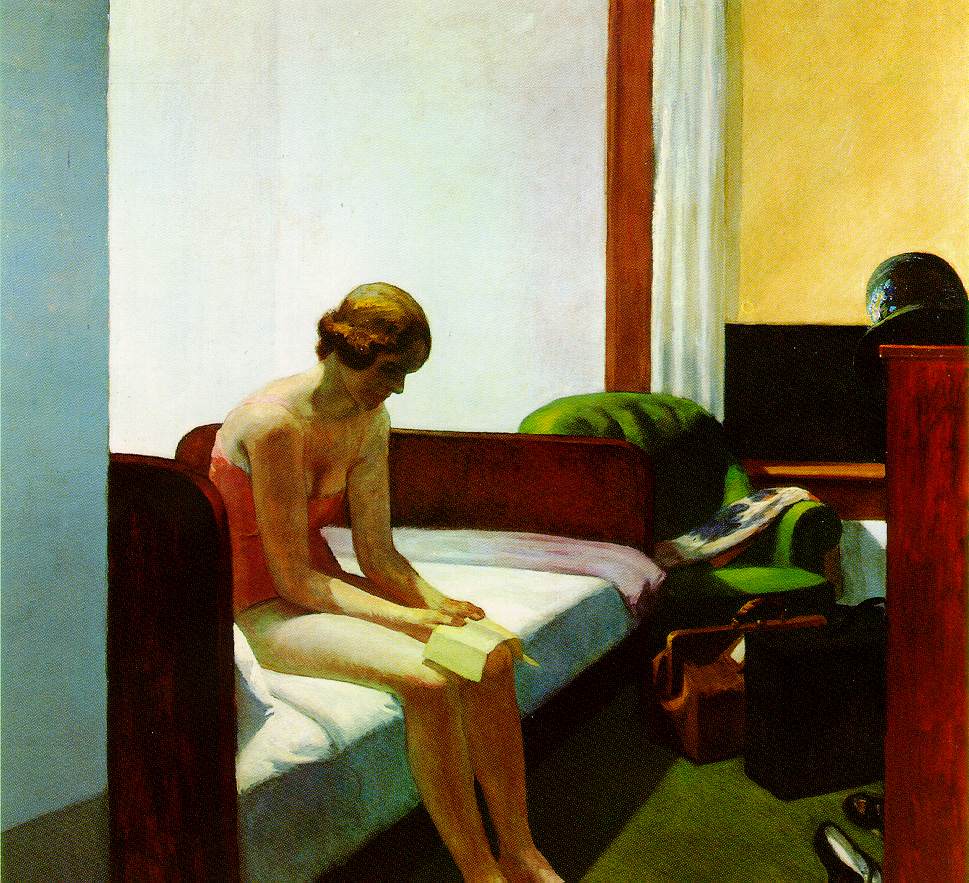
My favourite painter of solitude, Edward Hopper Hotel Room, 1931

I'm reading On Solitude by French Renaissance philosopher Michel de Montaigne. Thus far, I have concluded that is a treatise on free-will. And, since I have ceased to be an academic (for the time being), I feel no shame for making this sweeping assumption 29 pages into this 120 page book. (Well, maybe I feel a little shame since I felt the need to qualify my conclusions).

In his first chapter "On Solitude" Montaigne weaves his decades' long research of philosophy (he says he prefers the Ancients - Romans rather than Greeks) to build an argument for the fact that solitude is not being alone but, instead, the result of being a part of society. To support this he cites a question from Persius:

Does knowing mean nothing to you, unless someone else knows that you know it?

In other words, does the knowledge you acquire mean anything if you do not share it? Well, yes and no. Knowledge informs and reshapes how you see the world. Knowledge either becomes a direct statement or an unconscious trigger of actions/reactions therefore, it is always shared with someone else.

Perhaps more critically, this question relates to our current state of social media. If we don't share our experience/our knowledge, does it exist? We see something interesting on the street: we tweet it, we Instagram it, we "status" it. Does this mean that we seek approval from others in order to believe that we know?

It may seem frightening to think of social media plays this role in our knowledge: in order to prove that we know anything we have to make it publicly known and affirmed ("liked" "favourited"). But, it points directly back to Montaigne's title: On Solitude. The act of knowledge, something that seems so intimate and subjective, is actually dependent on the act of the communal experience. Knowledge is a feedback loop and points to our place as social beings, rather than beings existing in an imaginary solitude.

With just this one question I paused from reading - trying to figure it out before I continue, sharing my knowledge in an attempt to prove that I know something about knowing and maybe that I am not alone.